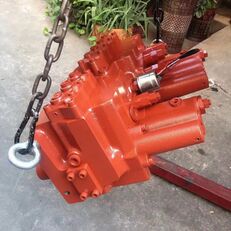
4398652 hydraulic control valve for Hitachi ZX200-6 midi excavator


If you decide to buy equipment at a low price, make sure that you communicate with the real seller. Find out as much information about the owner of the equipment as possible. One way of cheating is to represent yourself as a real company. In case of suspicion, inform us about this for additional control, through the feedback form.
Before you decide to make a purchase, carefully review several sales offers to understand the average cost of your chosen equipment. If the price of the offer you like is much lower than similar offers, think about it. A significant price difference may indicate hidden defects or an attempt by the seller to commit fraudulent acts.
Do not buy products which price is too different from the average price for similar equipment.
Do not give consent to dubious pledges and prepaid goods. In case of doubt, do not be afraid to clarify details, ask for additional photographs and documents for equipment, check the authenticity of documents, ask questions.
The most common type of fraud. Unfair sellers may request a certain amount of advance payment to “book” your right to purchase equipment. Thus, fraudsters can collect a large amount and disappear, no longer get in touch.
- Transfer of prepayment to the card
- Do not make an advance payment without paperwork confirming the process of transferring money, if during the communication the seller is in doubt.
- Transfer to the “Trustee” account
- Such a request should be alarming, most likely you are communicating with a fraudster.
- Transfer to a company account with a similar name
- Be careful, fraudsters may disguise themselves as well-known companies, making minor changes to the name. Do not transfer funds if the company name is in doubt.
- Substitution of own details in the invoice of a real company
- Before making a transfer, make sure that the specified details are correct, and whether they relate to the specified company.
Seller's contacts

 +86 189 289...
+86 189 2896 5241


 China


 China


 China

 China
Product Overview
The ZX200‑6 was Hitachi's answer to a simple question: can a 20‑ton excavator work smoothly in combined operations without losing power in any single one? The Zaxis platform handles that through its main valve, which governs how pump flow is divided between boom, arm, bucket, swing and travel, moment to moment, as the operator moves two or three levers at once. References 4398652, 4478056 and the older 439‑8652 format all identify this block across production runs.
The failure mode on a worn block is subtle and specific to combined work. One function alone still feels strong, but pair the boom with the swing and the house lags. Curl the bucket while tracking and the tracks fall behind. Hold a loaded bucket and the boom sinks, forcing a correction mid‑pass. The cause is internal leakage: spools that no longer isolate their circuits let oil migrate, so pressure that should serve one function bleeds into another. This aftermarket main valve replaces the complete assembly with fresh internals set to Zaxis pressure values, so the worn block unbolts as one unit and the replacement goes back in the original hose positions.
Core Advantages
1. Combined operations hold their balance
The Zaxis reputation rests on doing two things at once without losing either. Restored circuit isolation gives that back, so boom‑and‑swing and curl‑and‑track stop competing.
2. All three reference formats covered
Numbers appear with and without the dash in parts systems. We read your tag against the full set and confirm the exact block before it ships.
3. Loads stay where they were placed
A sinking boom on a held bucket costs a correction every pass. Renewed spool clearances keep pressure on the cylinder, so the bucket holds while the operator looks away.
4. Travel keeps pace with attachment work
With cross‑circuit leakage stopped, track speed stays even when the bucket is loaded, which matters on grade work and soft ground.
5. Whole‑block replacement ends repeat repairs
Once several circuits drift, piecemeal fixes become a cycle of return visits. One tested assembly resolves every circuit in a single installation.
Manufacturing & Quality Control
Spool and bore pairs are machined to drawing tolerance, matched by size, and hand‑run‑in until they travel freely with no stick‑slip. Assembled blocks are flow‑tested circuit by circuit on the bench, with relief and compensator values recorded against Zaxis figures; anything out of window is rebuilt before release. Units ship internally oil‑fogged, ports capped, and crated on foam.
Frequently Asked Questions
Q1: Are these three numbers all the same valve?
A: They identify the same family across production runs; 439‑8652 is simply the older written format. Send the serial and a tag photo and we confirm the exact configuration your machine carries.
Q2: Why does the machine feel fine on single functions but weak in combined work?
A: That pattern is typical of internal leakage. Single functions can absorb the loss; combined operations expose it because two circuits are drawing on the same pump at once. A circuit leak test confirms.
Q3: Is a repair kit enough, or does the block need replacing?
A: If the casting is sound and it has never been rebuilt, a spool kit may work. Where several circuits are affected, a complete assembly is usually the more economical answer. We will say which after seeing photos.
Q4: How much machine time should be planned?
A: Most of a working day for removal and refit with the cover open, plus bleeding and pressure verification. Schedule the machine out rather than hoping to finish between jobs.
Q5: What hydraulic servicing goes with the swap?
A: Flush the system, renew the return filter, clean the suction strainer, and refill with specified oil. Cross‑contaminated oil is the fastest way to lose new clearances.
Q6: What is excluded from warranty?
A: Material and assembly defects are covered. Failures from dirty oil, water entry, a spool forced against a mechanical bind, or reliefs set outside specification are not. Photograph the crate before opening if damage is visible.